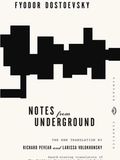
Notes from Underground - By Fyodor Dostoevsky
ISBN: 978-0679734529
DATE READ: 2026-03-31
HOW STRONGLY I RECOMMEND IT: 4/5
(See my list of books, for more.)
Go to the Amazon page for details and reviews.
Now, I am living out my life in my corner, taunting myself with the spiteful and useless consolation that an intelligent man cannot become anything seriously, and it is only the fool who becomes anything.
I swear, gentlemen, that to be too conscious is an illness.
‘Upon my word, they will shout at you, it is no use protesting: it is a case of twice two makes four! Nature does not ask your permission, she has nothing to do with your wishes, and whether you like her laws or dislike them, you are bound to accept her as she is, and consequently all her conclusions. A wall, you see, is a wall... and so on, and so on.’
but in spite of all these uncertainties and jugglings, still there is an ache in you, and the more you do not know, the worse the ache.
My jests, gentlemen, are of course in bad taste, jerky, involved, lacking self-confidence. But of course that is because I do not respect myself. Can a man of perception respect himself at all?
Come, can a man who attempts to find enjoyment in the very feeling of his own degradation possibly have a spark of respect for himself?
Perhaps I consider myself an intelligent man, only because all my life I have been able neither to begin nor to finish anything.
In any case civilisation has made mankind if not more bloodthirsty, at least more vilely, more loathsomely bloodthirsty.
They say that Cleopatra was fond of sticking gold pins into her slave-girls’ breasts and derived gratification from their screams and writhings.
You will say that that was in the comparatively barbarous times; that these are barbarous times too, because also, comparatively speaking, pins are stuck in even now; that though man has now learned to see more clearly than in barbarous ages, he is still far from having learnt to act as reason and science would dictate.
But yet you are fully convinced that he will be sure to learn when he gets rid of certain old bad habits, and when common sense and science have completely reeducated human nature and turned it in a normal direction.
What has made them conceive that man must want a rationally advantageous choice? What man wants is simply INDEPENDENT choice, whatever that independence may cost and wherever it may lead. And choice, of course, the devil only knows what choice.
For who would want to choose by rule? Besides, he will at once be transformed from a human being into an organ-stop or something of the sort; for what is a man without desires, without free will and without choice, if not a stop in an organ? What do you think? Let us reckon the chances—can such a thing happen or not?
You see, gentlemen, reason is an excellent thing, there’s no disputing that, but reason is nothing but reason and satisfies only the rational side of man’s nature, while will is a manifestation of the whole life, that is, of the whole human life including reason and all the impulses.
And although our life, in this manifestation of it, is often worthless, yet it is life and not simply extracting square roots.
Give him economic prosperity, such that he should have nothing else to do but sleep, eat cakes and busy himself with the continuation of his species, and even then out of sheer ingratitude, sheer spite, man would play you some nasty trick.
He would even risk his cakes and would deliberately desire the most fatal rubbish, the most uneconomical absurdity, simply to introduce into all this positive good sense his fatal fantastic element.
But man is a frivolous and incongruous creature, and perhaps, like a chess player, loves the process of the game, not the end of it.
I admit that twice two makes four is an excellent thing, but if we are to give everything its due, twice two makes five is sometimes a very charming thing too.
And why are you so firmly, so triumphantly, convinced that only the normal and the positive—in other words, only what is conducive to welfare—is for the advantage of man?
Is not reason in error as regards advantage? Does not man, perhaps, love something besides well-being?
Perhaps he is just as fond of suffering? Perhaps suffering is just as great a benefit to him as well-being? Man is sometimes extraordinarily, passionately, in love with suffering, and that is a fact.
You see, if it were not a palace, but a hen-house, I might creep into it to avoid getting wet, and yet I would not call the hen-house a palace out of gratitude to it for keeping me dry.
Every man has reminiscences which he would not tell to everyone, but only to his friends. He has other matters in his mind which he would not reveal even to his friends, but only to himself, and that in secret.
But there are other things which a man is afraid to tell even to himself, and every decent man has a number of such things stored away in his mind.
The more decent he is, the greater the number of such things in his mind.
Besides, I am bored, and I never have anything to do. Writing will be a sort of work. They say work makes man kind-hearted and honest. Well, here is a chance for me, anyway.
In fact, it happened at times that I thought more highly of them than of myself. It somehow happened quite suddenly that I alternated between despising them and thinking them superior to myself.
People say it’s a trial to have children. Who says that? It is heavenly happiness! Are you fond of little children, Liza? I am awfully fond of them.
You know—a little rosy baby boy at your bosom, and what husband’s heart is not touched, seeing his wife nursing his child! A plump little rosy baby, sprawling and snuggling, chubby little hands and feet, clean tiny little nails, so tiny that it makes one laugh to look at them; eyes that look as if they understand everything.
And while it sucks it clutches at your bosom with its little hand, plays. When its father comes up, the child tears itself away from the bosom, flings itself back, looks at its father, laughs, as though it were fearfully funny, and falls to sucking again.
Or it will bite its mother’s breast when its little teeth are coming, while it looks sideways at her with its little eyes as though to say, ‘Look, I am biting!’ Is not all that happiness when they are the three together, husband, wife and child? One can forgive a great deal for the sake of such moments. Y
es, Liza, one must first learn to live oneself before one blames others!’
don’t rely upon your youth—all that flies by express train here, you know.
You will be kicked out. And not simply kicked out; long before that she’ll begin nagging at you, scolding you, abusing you, as though you had not sacrificed your health for her, had not thrown away your youth and your soul for her benefit, but as though you had ruined her, beggared her, robbed her.
horrible spite against her suddenly surged up in my heart; I believe I could have killed her.
To revenge myself on her I swore inwardly not to say a word to her all the time. ‘She is the cause of it all,’ I thought.
I did not hate her so much, however, when I was running about the room and peeping through the crack in the screen. I was only insufferably oppressed by her being here.
I wanted her to disappear. I wanted ‘peace,’ to be left alone in my underground world. Real life oppressed me with its novelty so much that I could hardly breathe.
So that perhaps, after all, there is more life in me than in you. Look into it more carefully! Why, we don’t even know what living means now, what it is, and what it is called? Leave us alone without books and we shall be lost and in confusion at once.
We shall not know what to join on to, what to cling to, what to love and what to hate, what to respect and what to despise.
We are oppressed at being men—men with a real individual body and blood, we are ashamed of it, we think it a disgrace and try to contrive to be some sort of impossible generalised man.
We are stillborn, and for generations past have been begotten, not by living fathers, and that suits us better and better. We are developing a taste for it.
Soon we shall contrive to be born somehow from an idea. But enough; I don’t want to write more from ‘Underground.’